
-
 Media gallery

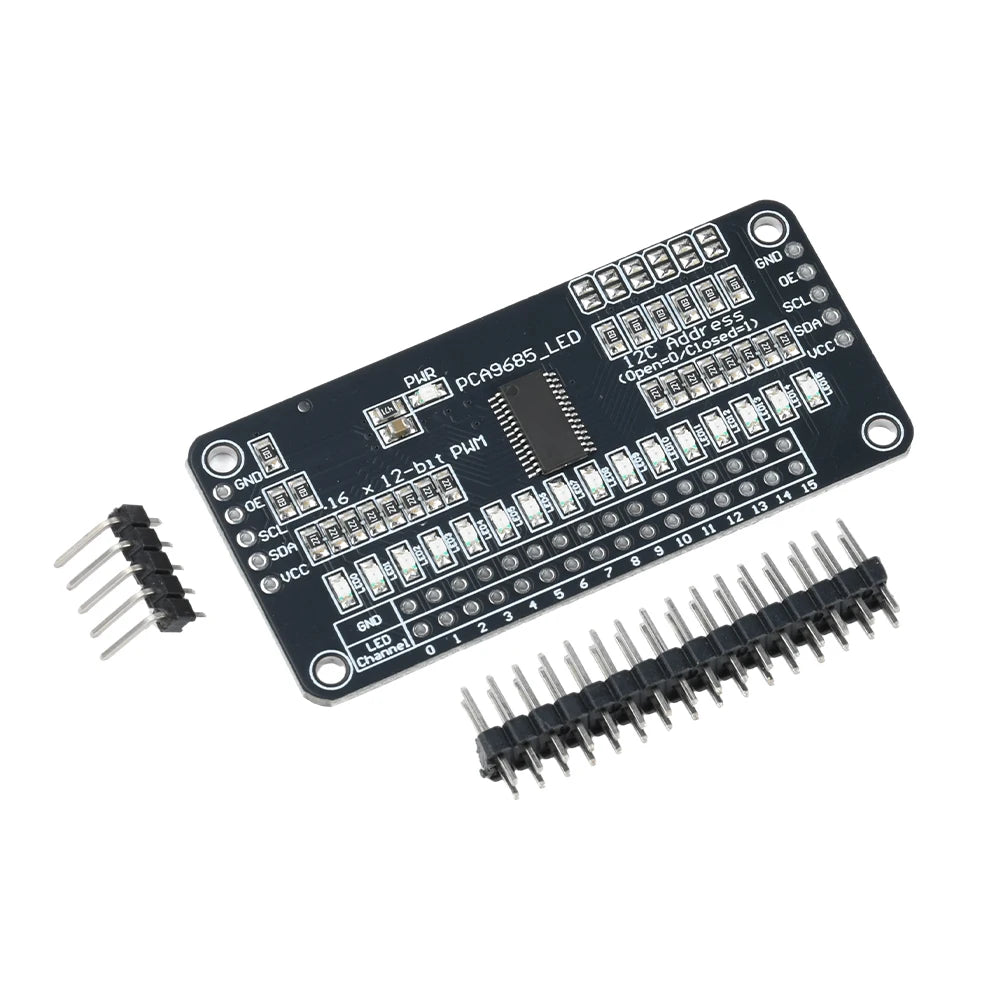
PCA9685 16-Channel 12-Bit PWM I2C LED Driver Module | ATMOSFÆR ENGINEERING
- Regular price
- €13,99
- Regular price
-
- Sale price
- €13,99
- Unit price
- per
Couldn't load pickup availability
Have a question?
Notified by email when this product becomes available

€13,99
- Description
Professional 16-channel PWM controller with I2C interface for precise LED brightness control and servo motor driving. Features 12-bit resolution (4096 levels) for smooth, flicker-free dimming and programmable frequency up to 1526Hz. Ideal for RGB/RGBA LED strips, multi-servo robotics, and complex lighting projects requiring independent channel control with minimal GPIO usage.
Technical Specifications:
- IC: PCA9685 (NXP/TI)
- Interface: I2C (TWI)
- Channels: 16 independent PWM outputs
- Resolution: 12-bit (4096 brightness levels)
- PWM Frequency Range: 24Hz - 1526Hz (programmable)
- Duty Cycle: 0% - 100% (independent per channel)
- Operating Voltage: 2.3V - 5.5V (logic and power)
- I/O Voltage Tolerance: 5.5V max
- Output Current: 25mA sink (typical @ 5V), 10mA source
- I2C Address: 0x40 (default), configurable via solder jumpers (up to 62 devices on one bus)
- Clock Source: Internal oscillator or external clock input (up to 50MHz)
- Standby Current: Low power consumption
- Built-in Features: Power-on reset, output enable pin
- PCB Dimensions: 62mm x 29mm
- Operating Temperature: -40°C to +85°C (typical)
Pin Configuration:
- VCC: Power supply (2.3V - 5.5V)
- GND: Ground
- SDA: I2C data line
- SCL: I2C clock line
- OE: Output enable (active low, optional)
- EXTCLK: External clock input (optional)
- V+: LED power supply (separate from logic, up to 6V typical)
- PWM0-PWM15: 16 independent PWM outputs
Address Configuration:
- Default I2C address: 0x40
- Configurable via 6 solder jumper pads (A0-A5)
- Allows up to 62 PCA9685 modules on single I2C bus
Features:
- 16 independent PWM channels with individual control
- High-resolution 12-bit PWM (smoother than 8-bit Arduino PWM)
- Programmable frequency for flicker-free LED control
- All channels share same frequency but independent duty cycles
- External clock synchronization for multi-board sync
- Directly drive LEDs up to 25mA per channel
- Can control servos (typical 50Hz operation)
- Minimal microcontroller load (I2C control only)
- Onboard oscillator (no external components needed)
- Staggered output switching reduces EMI
Included in Package:
- 1x PCA9685 PWM driver module
- 1x 15-pin straight header (for terminal connections)
- 1x 5-pin angled header (for I2C interface)
Applications:
- RGB/RGBA LED strip control (independent color channels)
- Multi-servo robotics (up to 16 servos from 2 GPIO pins)
- Architectural and stage lighting
- LED matrix driving
- PWM motor speed control (low-current motors)
- LCD backlight brightness control
- Custom LED animations and effects
- Multi-channel dimming systems
- Ambient lighting controllers
Typical Use Cases:
- RGB Lighting: Control 5+ RGB LED strips independently (3 channels per strip)
- Servo Control: Drive 16 servos simultaneously for robot arms, hexapods
- LED Effects: Create complex animations without blocking code execution
- Backlight Dimming: Smooth LCD/monitor backlight control
Connection Example (RGB LED Strip):
- VCC, GND, SDA, SCL → Microcontroller
- V+ → LED power supply (12V/24V)
- PWM0 → Red channel (via MOSFET for high-power strips)
- PWM1 → Green channel
- PWM2 → Blue channel
Servo Control:
- Set frequency to 50Hz (typical servo requirement)
- Connect servo signal wires to PWM outputs
- Power servos from V+ terminal (4.8V-6V typical)
Important Notes:
- For LEDs >25mA, use external MOSFETs (IRLZ44N recommended)
- Separate power supply recommended for high-current LED loads
- All 16 channels share the same PWM frequency (individually set duty cycle only)
- For servo control, use 50-60Hz frequency setting
- Pull-up resistors required on SDA/SCL (often built into microcontroller boards)
- Total current draw limited by power supply and PCB traces
Advantages over Arduino PWM:
- 16 channels vs 6 PWM pins (Arduino Uno)
- 12-bit (4096 levels) vs 8-bit (256 levels)
- Frees up microcontroller pins
- Hardware-based (no software timing required)
Compatible with Arduino, ESP32, Raspberry Pi, STM32, and any microcontroller with I2C support. Libraries available for Arduino IDE (Adafruit_PWMServoDriver) and Python (for Raspberry Pi).